Launch price $27 for now · goes up to $50 after launch Get it while it's $27 →

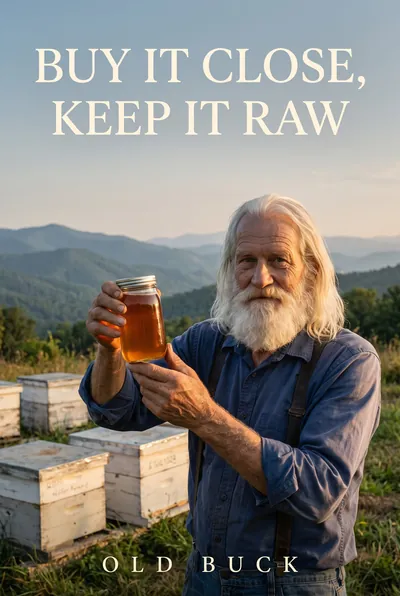
Old Buck · 52 years on one mountain

Buy It Close,
Keep It Raw

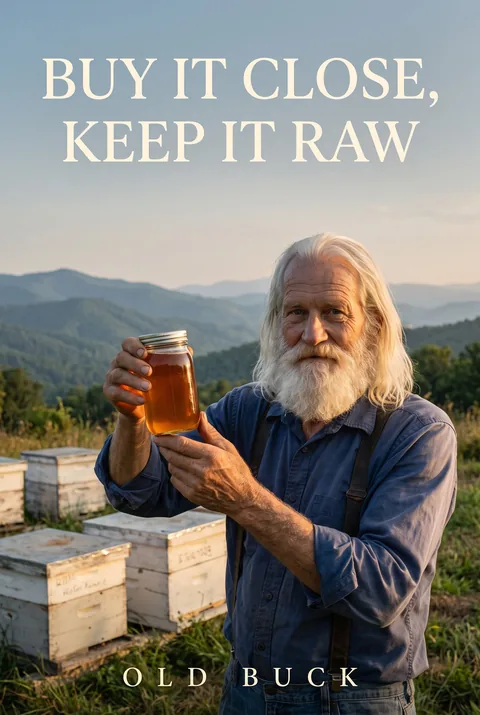
The book Buy It Close, Keep It Raw by Old Buck

You are not buying honey. You are buying whatever happened to it between the hive and the shelf.

  • Read any honey label in 10 seconds: who produced it, who only packed it, and where it came from.
  • Work out the real price per pound of any jar, and find out if buying close costs less.
  • Bring hard honey back with warm water and about 40 minutes, instead of throwing it out.

Launch price · Illustrated ebook · 184 pages · Instant download · 7-day refund

Chapter 5 says

Turn the jar around. Read the back first.

The front of a label is for selling. That is where the cartoon bee goes, and the meadow, and the big friendly words. The useful lines are on the back. So here is the back of this book, the way I would want you to read any jar.

A plain guide to real honey

Net contents
184 pages · 17 chapters · 14 printable pages
Produced by
Old Buck, 40 acres in a hollow off the Cane River, Yancey County, North Carolina. Produced, not packed.
Origin
One mountain, 52 years, pencil on every hive lid.
Ingredients
Stories, the reason behind each one, a free test you can do at home, a mistake I made, where the method has its limits, and a short list of things to do this week.
Handling
No sponsor. No product line. No brand to steer you toward. Every outside number has its source named.
Not a claim
Not medical advice. Nothing in it says honey treats or cures anything.
Price
$27 once. About 15¢ a page. Do the arithmetic.
Get the book · $27

Who I wrote it for

Three kinds of people kept asking me the same questions.

The person in the kitchen

You have never kept a bee and never will. You eat honey. You buy honey. You deserve to know what you are paying for. Parts One and Two are written for you first.

The one buying the plastic bear

I am not going to shame you for it. Some of that honey is fine, and you cannot tell which from the shelf. I will show you the arithmetic on buying direct. You may find you were priced out of a label, not out of honey.

The beginner with one hive

A full suit, gloves up to your elbows, and a shelf of things the catalog said you needed. You did nothing wrong. If you lost a hive last winter, I lost my first one too, and I will tell you how.

From Chapter 6 · Buying Close

You have not been priced out of real honey. You have been priced out of the label on it.

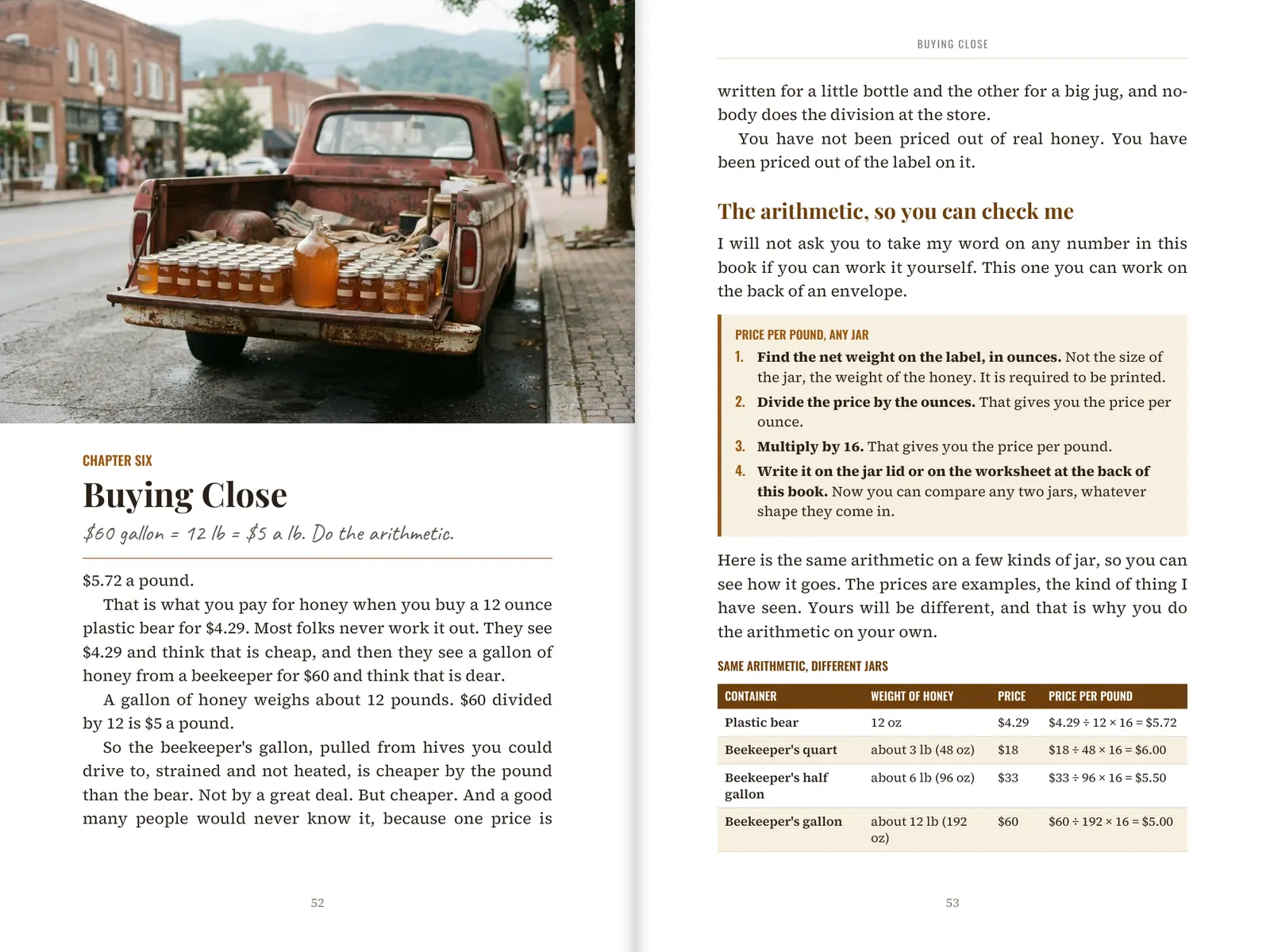
A 12 ounce plastic bear for $4.29 looks cheap. A gallon from a beekeeper for $60 looks dear. Nobody does the division at the store. Do it here, with the jar in your own pantry.

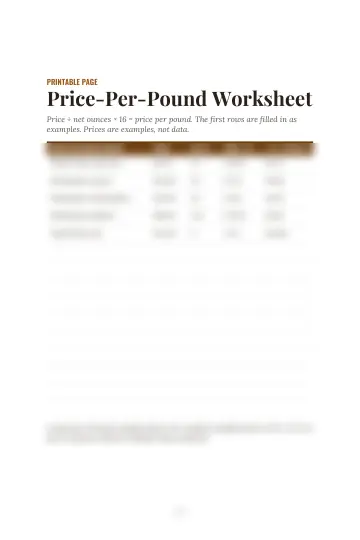
Price per pound, any jar

Your jar: $5.72 a pound

The beekeeper's gallon is the book's example: $60 for about 12 pounds. Prices where you live will be different, and that is why Chapter 6 teaches you to work it out yourself.

What is inside

Seventeen chapters, each with a pencil note, the way I write on my hive lids.

Each chapter answers one question a person has actually asked me. The book walks the same road you do: you buy honey, you store it, and maybe one day you keep the bees.
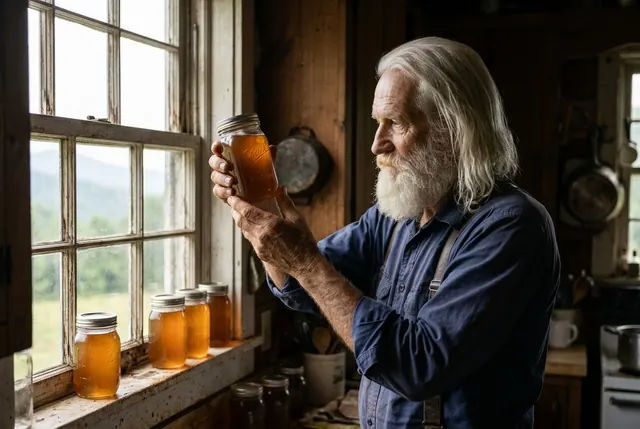
Old Buck at the kitchen window holding a jar of honey up to the light

Part One

The Jar

What you are buying, and how to tell.

See the 6 chapters
  1. 1Whatever Happened to ItFall. 30 hives. All heavy. Honey on the sill.
  2. 2What Honey IsJune. Ear to the gum after dark. Roaring.
  3. 3Between the Hive and the ShelfHoney that has been hurried tastes hurried.
  4. 4The Thumb Test and Other Things I Got WrongThumb test: wrong. 15 years. Corrected.
  5. 5Reading the JarRead the back first. The front is selling.
  6. 6Buying Close$60 gallon = 12 lb = $5 a lb.
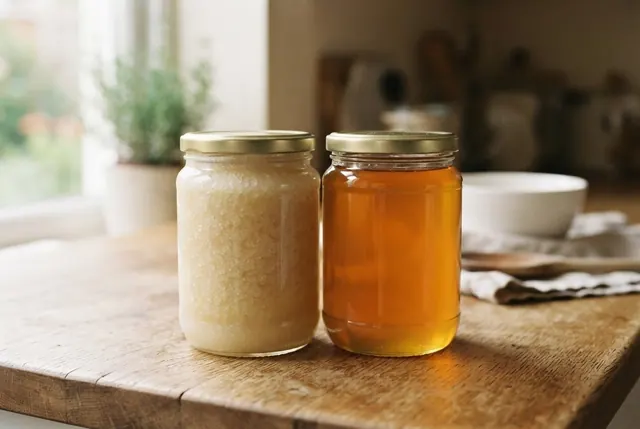
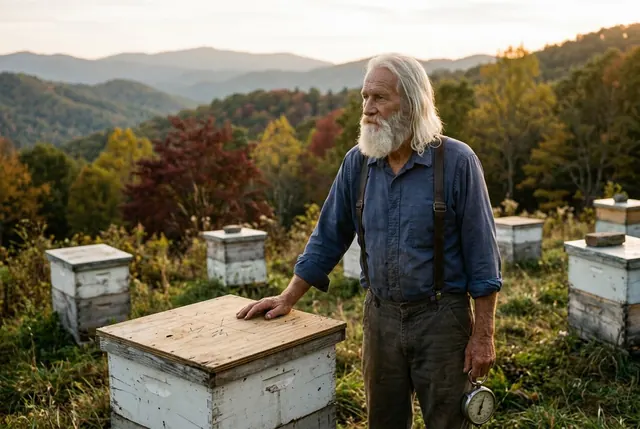
A jar of crystallized honey next to a jar of runny honey

Part Two

The Pantry

The honey you have once you get it home.
See the 8 chapters
  1. 7The Mountain's Year in HoneyPoplar in May. Sourwood in July. Goldenrod is theirs.
  2. 8Sourwood, HonestlyPoplar off in June. Sourwood clean.
  3. 9Crystallized Is Not SpoiledHard is not bad. Warm water. 40 minutes.
  4. 10When Honey Goes SourUncapped. Put it back. Wait for the caps.
  5. 11Keeping Honey for Years1 gal sourwood. 2 qt poplar. Wife counted.
  6. 12Creamed Honey the Springhouse WaySeed 1:10. 75°F. Back room 57°F.
  7. 13Honey in the Kitchen, PlainlyWife says: wipe the jar. Every time.
  8. 14Honey Safety, Said Once and PlainlyNo honey before the first birthday.
Old Buck with his hand on a hive lid in the bee yard in fall

Part Three

The Hive

For the beekeeper, or the person thinking about it.

See the 3 chapters
  1. 15The Hive That Makes the HoneySmoker. Tool. Pencil. That is the kit.
  2. 16Reading a Hive from the OutsideOct. Back 31 lb. x2 = 62. Empty 52. Short.
  3. 17Leave Them Their ShareOct. Weighed all 30. Fed the short ones.

The back of the book

Print them, cut them out, carry them in a wallet or a truck. They are meant to be written on and gotten sticky. Print as many as you like for your own household.
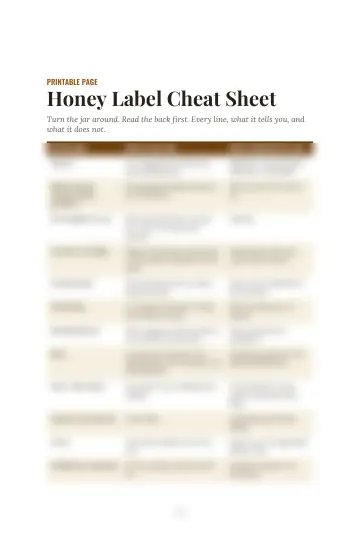
  • Honey Label Cheat Sheet
  • Questions to Ask a Beekeeper
  • Price-Per-Pound Worksheet
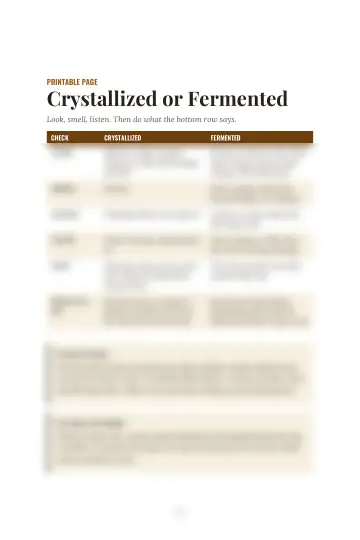
  • Crystallized or Fermented
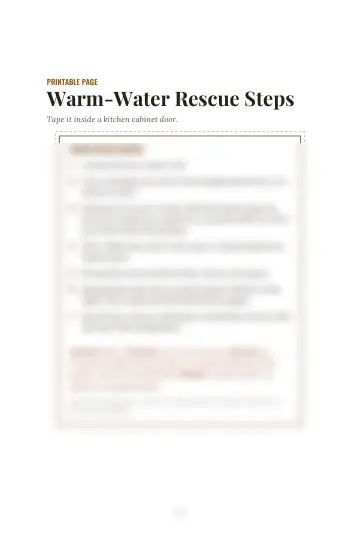
  • Warm-Water Rescue Steps
  • Creamed Honey Batch Log
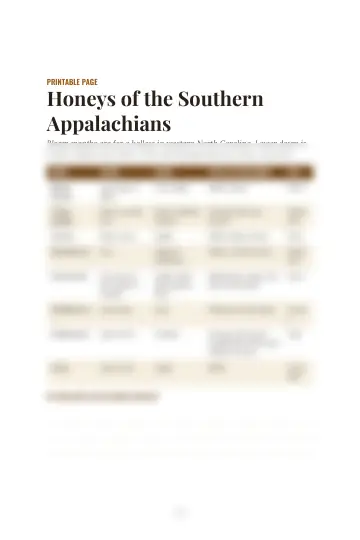
  • Honeys of the Southern Appalachians
  • Pantry Honey Inventory
  • Hive Weight Log
  • Winter Stores Quick Guide
  • Fall and Winter Feeding Card
  • A Mountain Beekeeper's Year
  • Hive Listening Guide
  • Honey Safety Page

Look inside

These are the real pages.

Straight out of the book, not a mock-up. Tap a spread to see it full size.
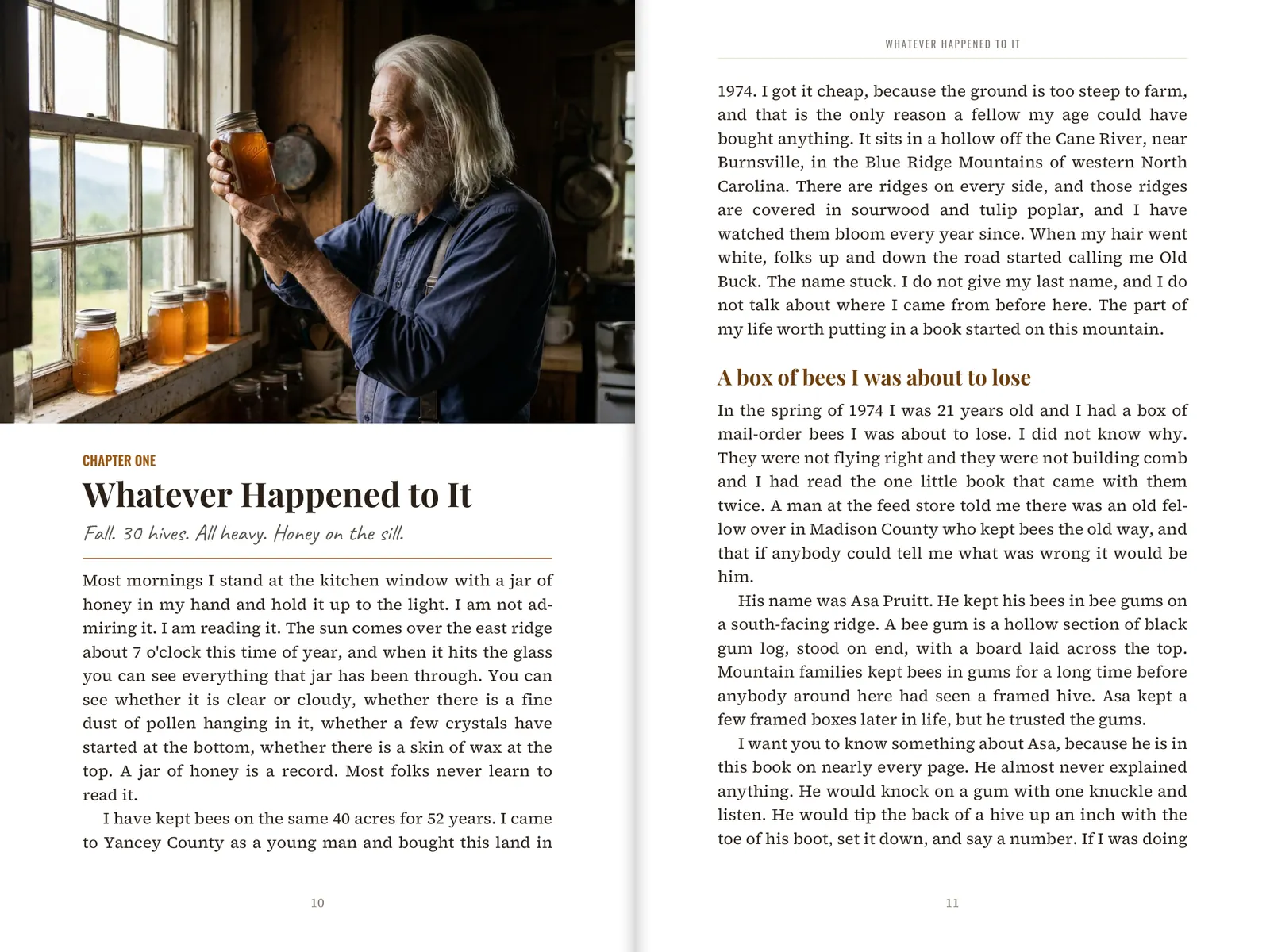
Pages 10 and 11: the opening of Chapter One, Whatever Happened to It
Pages 10–11. Chapter 1 opens at the kitchen window, reading a jar in the morning light.
Pages 52 and 53: Chapter Six, Buying Close, with a price-per-pound table
Pages 52–53. Chapter 6: the price-per-pound arithmetic, so you can check me.
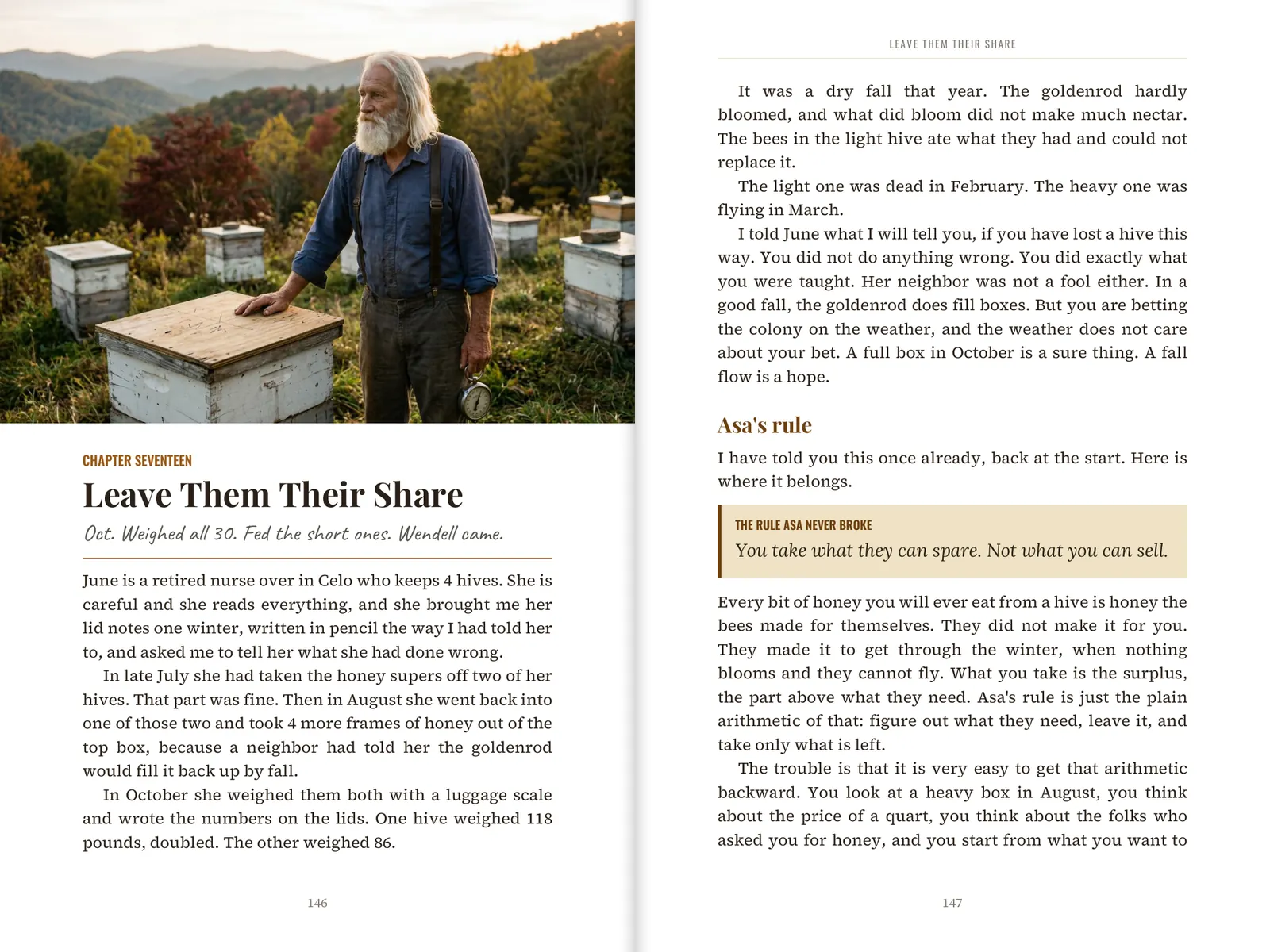
Pages 146 and 147: Chapter Seventeen, Leave Them Their Share
Pages 146–147. Chapter 17: how much to take, and how much to leave for February.
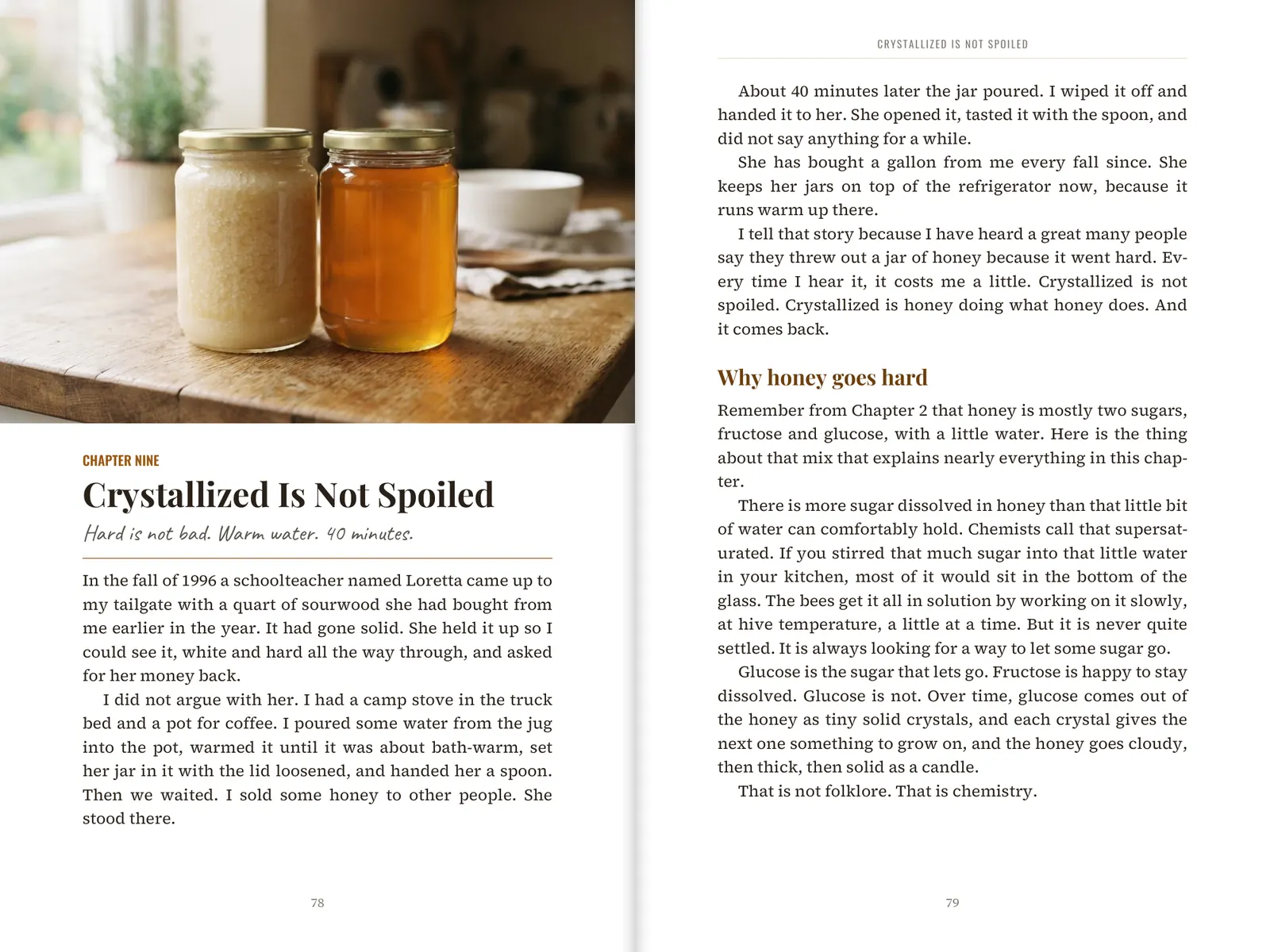
Pages 78 and 79: the opening of Chapter Nine, Crystallized Is Not Spoiled
Pages 78–79. Chapter 9: why honey goes hard, and why that is nothing to fear.

Corrected in pencil

Things I believed, and what the bees taught me instead.

A man who will not tell you what he got wrong should not be trusted on anything else. So here are mine. Each one is in the book, in its proper place.
  • Take a good crop in August. They will manage.My first hive starved, February 1976.Chapter 17
  • Warm it on the stove so it runs through the cloth faster.Sold a crop that tasted like somewhere else.Chapter 3
  • Pull the frames now, they are nearly done.Uncapped. Went sour. Wait for the caps.Chapter 10
  • A drop on your thumb tells real honey from fake.It cannot. Told folks for 15 years. Corrected.Chapter 4
Old Buck in a rocking chair on his porch, facing the bee yard
On the porch, facing the bee yard.

The beekeeper

Old Buck

I have kept bees on the same 40 acres off the Cane River since 1974. I bought the land cheap because it was too steep to farm. I learned from an old mountain beekeeper named Asa Pruitt, who kept his bees in bee gums on a ridge in Madison County and almost never explained anything.

For the better part of 30 years I kept bees for money. At my biggest I ran 140 hives and sold sourwood honey by the quart off my truck tailgate on the square in Burnsville. Today I run 30, for my own people and for the bees.

  • $40 hand-crank extractor, bought in 1981. Still turning.
  • $12 luggage scale. Every hive weighed with it since 1998.
  • 1979 the first fall of creamed honey, from one line of seed ever since.

Not a scientist, an inspector, or a salesman. I sell nothing but this book.

Watch me on YouTube: Old Buck Knows →

At the end of the drive

Buy it close

$27

Buy it close, keep it raw, leave them their share. If you forget everything else in the book, keep those three. The other 184 pages are the reasons why.

  • The full illustrated book: 184 pages, 17 chapters
  • 14 printable pages for the kitchen, the wallet, and the bee yard
  • Download link on screen and by email, right after you pay
  • Read it on any phone, tablet, or computer, or print it
Get the book $27

$27 is the launch price. It goes up to $50 after launch, so get it while it lasts.

7-day refund. If it is not for you, write within 7 days and you get your money back.

Short answers

Questions folks ask before they buy.

What exactly do I get?

An illustrated ebook of 184 pages, delivered as a PDF file. The pages are 6 by 9 inches (15.2 × 22.9 cm), the size of a regular paperback. It has bookmarks for every chapter and printable page, so you can jump straight to the one you want.

When do I get it?

Right away. The book is sold through Gumroad. As soon as your payment goes through, you get a download link on the screen and in an email receipt, and you can come back to that link any time.

Can I read it on my phone?

Yes. It opens on any phone, tablet or computer. The paperback page size reads comfortably on a phone screen.

Can I print it?

Yes. It prints on ordinary US Letter or A4 paper. The 14 printable pages at the back are made for printing, and you may print as many copies as you like for your own household.

I have never kept a bee. Is this for me?

Yes, you first. Parts One and Two are written for the person in the kitchen and at the store. You can stop after Chapter 14 and have everything you need. Part Three is there if you get curious.

Is this a printed book?

No, it is a digital book only. Nothing is mailed to you.

What if it is not for me?

Write within 7 days of buying and you get your money back. Refunds go through Gumroad, back to the card or account you paid with.

Is this medical advice?

No. It is one beekeeper's experience and general information. Nothing in it claims that honey treats or cures anything. And never give honey to a child under 12 months old.